Israelitische Kultusgemeinde München und Oberbayern

Jump to:

How to Get Here

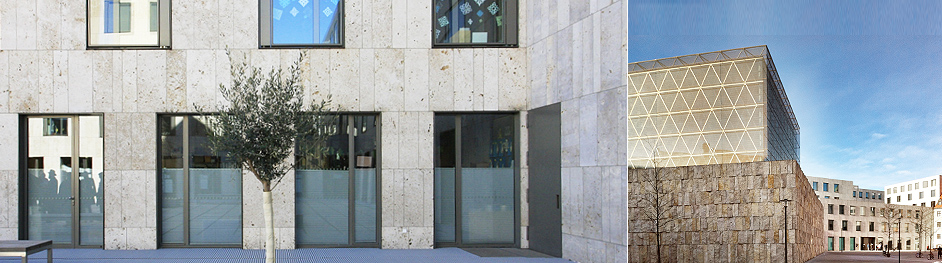
The Jewish Community Center (JCC) along with the Ohel Jakob synagogue are located at St.-Jakobs-Platz 18, at the heart of Munich’s old town.

From Munich Airport

For most travelers, the suburban train or S-Bahn is the fastest, cheapest, and most reliable way to get from Munich Airport to the city center. Lines S1 and S8 run towards the city from the airport, reaching central Marienplatz after approximately 40 minutes. From there, the main synagogue and JCC are only a few minutes‘ walk away.
Tickets can be purchased through the DB Navigator and MVG apps as well as through vending machines at most stations. Taxis are available at a cost of around €80-100 for a single trip.

From Munich main station („Hauptbahnhof“)

  • Take the subway („U-Bahn“) line U1 in the direction of Mangfallplatz or U2 in the direction of Messestadt Ost for one stop, exit at Sendlinger Tor. From there, walk for about five minutes to St.-Jakobs-Platz. Total travel time: 10-15 minutes
  • Take the suburban train („S-Bahn“) to Marienplatz, then walk to St.-Jakobs-Platz. Total travel time: 10-12 minutes

A short trip ticket costs €1.90, tickets are available at local vending machines or through the MVG app.

Alternatively, you can take a taxi directly from the main station. The ride takes about 5 to 8 minutes, depending on traffic, and costs approximately €10 to €14.
Please note: Travel by taxi is not advisable during rush hour as streets in and around the old town are often congested. Public transport is generally the faster option.


Where to Stay

The following hotels are Shabbat-friendly and within walking distance from the main synagogue:

Hotel Blauer Bock
Sebastiansplatz 9
80331 München
+49 89 231880
info@hotelblauerbock.de

Hotel Altmünchen
An der Hauptwache 14
80331 München
+49 89 231780
altmuenchen@blattl.de

Pension Seibel
Reichenbachstr. 8
80469 München
+49 89 2319180
info@seibel-pension.de

Hotel Atlanta
Sendlinger Str. 58
80331 München
+49 89 263605
info@hotel-atlanta.de

Hotel Olympic
Hans-Sachs-Str. 4
80469 München
+49 89 231890
info@hotel-olympic.de


Where to Eat

Restaurant Einstein

St.-Jakobs-Platz 18
80331 Munich

The only glatt-kosher restaurant in Munich, the Einstein offers a wide array of central and Eastern European as well as Israeli dishes. The Einstein’s mashgiach operates under the supervision of the chief rabbi of Munich.

  • Opening hours:
    • Monday–Friday 12:00 PM – 2:30 PM
    • Monday–Thursday 6:00 PM – 10:30 PM
    • closed on Saturdays (Shabbat) and public and Jewish holidays

Kindly take note that the Einstein will be closed for remodeling works August 25 through 31.
Limited menu options will be on offer September 2 through 12.

  • Friday night dinners (Shabbat) are available for groups of 10+ people with advance reservation.
  • Takeout & delivery: available for pickup and through services like Lieferando (Deliveroo equivalent)
  • www.einstein-restaurant.de
  • Kosher certification: Rabbinate of the Jewish Community of Munich and Upper Bavaria

Danel Feinkost – Kosher Deli & Grocery Store

Prinzregentenstraße 130
81677 München

Located in the Bogenhausen neighborhood, Danel offers certified kosher products, including deli foods, challah, pastries, and packaged goods.

  • Opening hours: Monday 9 AM – 5 PM, Tuesday 9 AM – 6 PM, Wednesday – Thursday 9 AM – 7 PM, Friday 9 AM – 1 PM; closed Saturday and Sunday
  • perfect for stocking up before Shabbat
  • No on-site dining – for self-catering only!

Shabbat Meals (alternative Options)

If you are in Munich on Shabbat and wish to partake in a kosher meal:

  • Private Shabbat dinners are hosted irregularly by
    • the Jewish Community of Munich and Upper Bavaria (IKG),
    • Chabad of Munich (chabadmunich.de)
    • platforms like Shabbat Around the World or Jewish travelers‘ WhatsApp groups

Prayers at the Main Synagogue

If you wish to join the prayer services at the main synagogue, known officially as the Ohel Jakob synagogue, please complete the guest registration form (Latin script only, one form for each individual visitor) and send it to tfila@ikg-m.de along with the following documents:

  • proof of religious affiliation or membership in a Jewish community (if applicable)
  • scan of your passport or ID card

The usual dresscode (covered head and long pants for men, covered shoulders, no low-cut dresses or short skirts for women) applies.

Synagoge


What to See

Jewish Landmarks and Sites in Munich

Jewish Center at St.-Jakobs-Platz

St. Jakobs-Platz

The heart of Jewish life in Munich, located in the city center, the Jewish Center includes

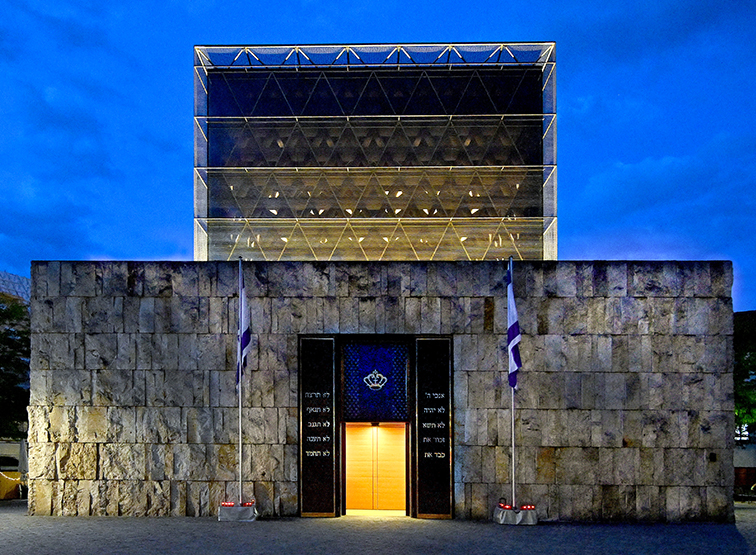
  • the Ohel Jakob Synagogue (main synagogue),
  • the Jewish Community Center (JCC), and
  • the municipal Jewish Museum Munich.

Constructed between 2003 and 2007, the three buildings have visibly returned Jewish life to the heart of Munich while also being impressive feats of modern architecture. Guided tours in English and Hebrew are available as capacities allow. Please note that as tours are often fully booked weeks in advance, we recommend reaching out the community as early as possible before your trip.

Jewish Museum Munich

The Museum, opened in March 2007, offers a deeper look into the history, and identity of Jewish life in Munich as well as into the religious practices of earlier and modern Jewish communities.

Open Tuesday–Sunday 10 AM – 6 PM

Holocaust Memorial Sites

Memorial at the Site of the Old Synagogue

A solitary memorial stone with an inscription in Hebrew marks the place where Munich’s old main synagogue once stood before being destroyed by the Nazis in June 1938.

Dachau Concentration Camp Memorial Site

A 20-minute drive from Munich, the site of the first concentration camp established by the Nazis in the spring of 1933 has been a memorial site since 1965. The memorial features several original buildings (including barracks, crematorium, and a gas chamber), a comprehensive exhibition on the site’s history and several educational exhibits, with audio guides available in Hebrew, English, and other langues. Several separate memorials around the site, including a large memorial dedicated to Jewish inmates, commemorate those who perished here.

General Cultural Highlights

Viktualienmarkt 

Munich’s historic and world famous food and flower market remains a must-see for every visitor. Lots of vegetarian, vegan, and Middle Eastern culinary options are on offer – sometimes even Israeli-style hummus/falafel. Right to the Viktualienmarkt is the central Marienplatz square, site of Munich’s old and new city halls as well as the famous Glockenspiel (plays daily at 11 AM and 12 PM; additional performance at 5 PM March through October)

Bavarian National Museum

The BNM displays its extensive collections of Bavarian and European art, history, and religious artifacts.

Munich Residenz (Royal Palace)

The former home of Bavaria’s rulers from the House of Wittelsbach, the Residenz is home to the grand architecture and lavish interiors one imagines when thinking of Europe’s old aristocratic splendor.

Recommendations for Israeli Tourists

Chabad House Munich

  • Location: Luitpoldstraße 10
  • Welcoming place for Israeli tourists and all Jews.
  • Offers:
    • Shabbat meals and prayer services
    • Tefillin, kiddush, candles, learning sessions
    • Support for kosher food and Jewish needs
  • Languages: Hebrew & English spoken by staff and community members

More Ideas for Jewish Visitors

  • English/Hebrew-language walking tours focusing on Jewish Munich are available (e.g., via Munich Walk Tours, GetYourGuide, JewishTravelEurope).
  • Jewish cemeteries: Such as the New Jewish Cemetery (Neuer Israelitischer Friedhof). Visits possible with advance notice, please contact the community for more info.
  • Jewish bookstore: Inside the Jewish Museum (opening hours apply), with Hebrew, German, and English books.

VeranstaltungenÜberblick »

September 2026 | Elul-Tischri | « »

Aktuelle Veranstaltungen


Do. 01.10.2026 | 20. Tischri 5787

Kultur

„Bruno – Der junge Kreisky“

Beginn 20:

Filmvorführung
Donnerstag, 1. Oktober 2026, 20 Uhr

Spielfilm, Österreich/ Deutschland 2026, 116 Min.

Regie: Harald Scheritz
Drehbuch: Harald Sicheritz, Fritz Schindlecker, Helene Maimann
Produktion: DOR Film, Wien
Darsteller: Nils Arztmann (Bruno), Maya Unger Adele Holzer), Soi Schüssler (Sissi Nesvadba), Noah Perktold (Roman Felleis) Juergen Maurer und Marie-Therese Futterknecht (Eltern Kreisky), Tobias Resch (Paul Kreisky) u. v. a.

Wien in den späten 1920er Jahren: Als Schüler aus wohlhabendem jüdischen Elternhaus wird Bruno Kreisky von der sozialistischen Arbeiterjugend nur widerwillig aufgenommen. Als die politischen Spannungen im Land eskalieren, organisieren Bruno und seine Kameraden und Kameradinnen verbotene Treffen, verteilen Widerstandspamphlete und setzen bei ihrer Revolte gegen reaktionäre Kräfte, die dem Anschluss Österreichs ans Dritte Reich entgegenfiebern, ihr Leben auf Spiel. Während sein Bruder Paul seine Rettung in der Alijah nach Palästina sieht, führt der Weg des jugendlichen Rebellen Bruno ins schwedische Exil und später als österreichischer Spitzenpolitiker auf die Weltbühne. Weiterlesen »

Mi. 07.10.2026 | 26. Tischri 5787

Kultur

»Sie kamen, um uns zu töten. Mein Leben als Jüdin vor und nach dem 7. Oktober« – Ein Abend mit Dafna Gerstner

Buchpräsentation & Gespräch mit der Autorin
Mittwoch, 7. Oktober 2026

Lesung: Ulla Wegener
Moderation: Richard Volkmann

Dafna Gerstner stammt aus Israel und lebt seit 2011 in Deutschland. 2023 wurde sie Zeugin des brutalen Massakers der Hamas vom 7. Oktober im Kibbuz Be’eri. Wie durch ein Wunder überlebte sie in einem nicht abschließbaren Schutzraum in der Wohnung ihres Bruders Eitan. Dreißig Menschen von dort, darunter Kleinkinder, wurden nach Gaza verschleppt – nicht alle haben die Geiselhaft überlebt. Es starben insgesamt 102 aus dem Kibbuz Be‘eri, darunter auch Dafnas Bruder Eitan, der als Mitglied der Bereitschaftseinheit das Leben zahlreicher Kibbuz-Mitglieder rettete im für ihn tödlichen Kampf gegen die Terroristen.

In ihrem Buch erzählt die Überlebende Dafna Gerstner vom Leben im Kibbuz vor und nach dem Massaker, aber auch davon, was es heißt zu überleben. Sie berichtet von den traumatischen Folgen des Terrorangriffs – sowohl für sie persönlich als auch für die israelische Gesellschaft. Doch auch die Spaltung der deutschen Gesellschaft hat ihr Leben als Jüdin in Deutschland verändert.

Weiterlesen »

Sa. 17.10.2026 | 6. Cheschwan 5787

Kultur

Zum 27. Mal: »Die lange Nacht der Münchner Museen

Beginn 20:30 Uhr:

Beitrag der IKG München und Oberbayern

Auf einen Blick:

Vorträge (je 30 Min.)
20:30 Uhr Dinah Zenker
22:00 Uhr Ellen Presser

Konzerte des Synagogenchors »Schma Kaulenu«
unter Leitung von David Rees
21:15 Uhr und 22:30 Uhr (ca. 30 Min.)

Eine Synagoge, wörtlich Ort der Zusammenkunft (zum Gebet), ist von zentraler Bedeutung für jüdisches Leben. Der Vortrag erläutert, woher der Name »Ohel Jakob kommt, ferner architektonische Besonderheiten und die Rolle der Musik.

Musikalische Begleitung: Luisa Pertsovska

Veranstaltungsort: Synagoge »Ohel Jakob«, St.-Jakobs-Platz 18, 80331 München

Das Restaurant Einstein im Jüdischen Gemeindezentrum bietet koschere Köstlichkeiten.

Das Ticket kostet 20 Euro und berechtigt zum Eintritt in über 100 beteiligte Häuser.

Weitere Informationen unter www.muenchner.de und www.ikg-m.de
Alle Veranstaltungen »

Israelitische Kultusgemeinde
Kontakt
Israelitische Kultusgemeinde
München und Oberbayern K.d.ö.R.
St.-Jakobs-Platz 18
80331 München
Tel: +49 (0)89 20 24 00 -100
Fax: +49 (0)89 20 24 00 -170
E-Mail: empfang@ikg-m.de